
The Betrayal Trauma Symptoms Checklist: What You're Experiencing Is Real
/
How to Know If You're Experiencing It:
This article is for informational purposes and is not a substitute for professional diagnosis or treatment. If you're having thoughts of harming yourself, call or text 988 right now.
As an APSATS-certified partner specialist providing betrayal trauma therapy for women in Utah, I want you to know three things before we go any further:
You're not crazy.
You're not overreacting.
What you're experiencing has a name, and it's treatable.
Some days you can't stop crying. Other days you feel nothing at all. You're checking his phone at 2 a.m., replaying old conversations for clues, snapping at your kids, forgetting why you walked into a room. And underneath it all runs the whisper: Maybe I'm overreacting. Maybe it's not that bad. Maybe I'm just crazy.
You keep asking yourself the same question: Is what I'm feeling normal?
Here is the checklist I walk through with new clients — every major symptom of betrayal trauma, organized by where it shows up in your life.
Take the Checklist
Below is a checklist of the most common symptoms betrayed partners experience in the weeks and months after discovering a partner's affair, pornography use, or compulsive sexual behavior. It's organized into seven categories.
How to use it: As you read, check off everything you've experienced since discovery — even intermittently, even once. There's no scoring system, no threshold, and no diagnosis at the end. What most partners report isn't a score — it's recognition. The experience of reading this list is usually: "Oh. So THAT's what that is. And it has a NAME."
That recognition matters: partners who can name their symptoms consistently report feeling less crazy, less alone, and more able to seek the right help. Unnamed symptoms feel like personal disintegration. Named symptoms are a condition — with research, tools, and treatment behind it.
If you recognize yourself in three or more categories below, what you're experiencing likely qualifies as betrayal trauma — a real, documented, treatable condition — and the last section tells you what to do about it.
Want a version you can print and check off by hand?
Download the free printable Symptoms Checklist — no email required.
Category 1: Sleep Disturbance
Do you experience any of the following since discovery?
☐ Difficulty falling asleep, even when exhausted
☐ Waking at 2–4 a.m., mind immediately replaying everything
☐ Vivid dreams or nightmares — about him, her, or the discovery itself
☐ Avoiding the bed (or sleeping separately) because of what happened there
☐ Sleeping far more than usual (crash sleeping)
☐ Exhaustion that rest doesn't touch
What's happening: Your nervous system is running a threat assessment it can't complete, so it refuses to clock out. This is one of the most universal betrayal trauma symptoms — and the most important one to address early, because sleep deprivation amplifies every other symptom on this list.
→ The treatment: The 3 A.M. Protocol, in the First 30 Days Survival Kit
Category 2: Intrusive Thoughts and Mental Movies
☐ Unwanted images of your partner with someone else — specific, vivid, unwanted
☐ Your brain generating graphic details you never actually witnessed ("filling in" scenes)
☐ Replaying conversations and moments, scanning them now for the lie
☐ Songs, places, dates, or phrases that hijack you without warning
☐ The images arriving during ordinary moments — cooking, driving, at work
☐ Trying to stop thinking about it, and thinking about it more
What's happening: These aren't choices or obsessions born of weakness. This is trauma memory processing itself — the brain attempting to file experiences that overwhelm its normal filing system. The more you fight the images, the louder they get.
→ The treatment: Label, Ground, Return, in the Survival Kit
Category 3: Panic and Anxiety
☐ Sudden racing heart, chest tightness, or feeling like you can't breathe
☐ Panic attacks — at triggers, or seemingly out of nowhere
☐ Constant background hum of dread or "waiting for the next bad thing"
☐ Startle response in overdrive (jumping at a text notification)
☐ Nausea, stomach upset, digestive problems with no other cause
☐ Feeling unreal or detached — like you're watching your life from outside
What's happening: Your threat-detection system received genuinely alarming information and is now calibrated to maximum sensitivity. A panic wave is a chemical surge that crests and passes — feeling like death, behaving like weather.
→ The treatment: The 90-Second Wave, in the Survival Kit
Category 4: Hypervigilance and Checking
☐ Checking his phone, email, browser history, or location — repeatedly
☐ Scanning his face, tone, and words for tells
☐ Forensic activity: receipts, mileage, statements, social media of the affair partner
☐ Unable to stop yourself even when you know the checking hurts you
☐ Feeling unable to relax when he's out of your sight
☐ Setting traps: test questions, ambush conversations
What's happening: This is your investigative system trying to finish an investigation it can never close. Each check delivers a fresh dose of stress chemistry and re-teaches the brain that checking is survival. It's a compulsion, not a character flaw — and it responds extremely well to treatment.
→ The treatment: Urge Surfing + the Checking Window, in the Survival Kit
Category 5: Appetite and Body Changes
☐ Appetite collapsed — food seems pointless or tastes like nothing
☐ Forgetting to eat entirely until dizziness or headache
☐ Weight loss or gain others have noticed
☐ Relying on caffeine to function, crashing hard in the afternoon
☐ Increased alcohol use to sleep or "take the edge off"
☐ New or worsening physical complaints: headaches, tension, pain, getting sick more often
What's happening: Trauma suppresses digestion and appetite — but your brain is burning enormous fuel right now. The body is also carrying chronic muscle tension and stress load, which produces genuine physical illness. Betrayal trauma shows up in the body as surely as in the mind.
→ The treatment: The Minimum Viable Food Protocol, in the Survival Kit
Category 6: Rumination and Obsessive Thinking
☐ The same questions looping for hours: How long? How many? Why her? Why this?
☐ Mentally reconstructing the timeline — again, and again, and again
☐ Interrogation planning: drafting questions for him in your head all day
☐ Thinking about the affair partner obsessively — comparing, wondering, raging
☐ Difficulty concentrating on anything else — work, books, conversation, TV
☐ Replaying your own memories, looking for what you missed ([Betrayal Blindness →](insert link) explains this one)
What's happening: Rumination is your problem-solving system applied to an unsolvable problem — the past. The loops aren't insanity; they're a brain trying to gain control over events that already happened. Contained, the loops can be worked. Uncontained, they colonize everything.
→ The treatment: The Questions List, in the Survival Kit
Category 7: Emotional Dysregulation and Decision Paralysis
☐ Emotional swings that scare you — fine one hour, sobbing or furious the next
☐ Numbness: feeling nothing at all, even about your children or things you love
☐ Rage you don't recognize as yourself — or that frightens you with its intensity
☐ Obsessing over the decision: stay or go, leave or work on it, endlessly, both ways
☐ Making impulsive decisions (or none at all)
☐ Feeling like you're "going crazy" — this one is so common it's practically diagnostic
What's happening: Your emotional regulation system — which relied partly on the attachment bond for stability — just lost its anchor, and your decision-making systems are operating under a flood of stress chemistry. Ambivalence isn't weakness; it's the normal starting state of betrayal recovery.
→ The treatment: The Big Freeze Rule, in the Survival Kit
Beyond the Seven: Other Common Experiences
Many partners also report symptoms that don't fit neatly into categories but are worth knowing are shared:
Identity disruption: "I don't know who I am anymore" — the collapse of the version of yourself that believed in this marriage
Shame spirals: feeling stupid, humiliated, gullible, or somehow responsible
Social withdrawal: pulling back from friends, family, church — especially couple-friends
Spiritual crisis: questions about God, faith, or a world that allowed this
Hyper-independence: refusing help, needing to prove you can handle everything alone
Comparison fixation: measuring yourself against the affair partner or pornography imagery (a specific wound with its own treatment)
Sexual symptoms: aversion to, or compulsive seeking of, intimacy (both are normal responses)
If you checked boxes here too, add them to the count.
And if you checked almost nothing except the numbness box — that counts too. Shutdown is a trauma response, not the absence of one.
What Your Checkmarks Mean
If you recognized yourself in three or more categories:
What you're experiencing has a name — betrayal trauma — and it's not a metaphor. Researchers (beginning with Jennifer Freyd's foundational work on betrayal trauma theory) established that harm done by someone we depend on for safety produces a distinct, often more severe symptom picture than trauma from strangers — precisely because the injury strikes the attachment system itself, the part of you designed to make the world feel safe. Your symptoms are the predictable, documented result of that injury. They are:
Not craziness
Not weakness
Not an overreaction
Not something you should be able to fix by willpower, prayer, or "just deciding to move on"
They are a treatable condition — with specialized therapy approaches (trauma-focused modalities like EMDR, partner-specialist care) that address exactly this cluster.
If you recognized yourself in one or two categories, you may be experiencing an adjustment or grief response rather than acute trauma — still real, still deserving of support, but possibly different in intensity.

Either way, the question that matters isn't the count. It's this: are these symptoms interfering with your ability to function — work, parenting, relationships, basic self-care — for more than a few weeks? If yes, that's your threshold. Trauma symptoms are time-limited weather when processed; they're persistent climate when untreated.
If you'd like to fill this out on paper — or bring it to your doctor or a therapist — download the printable PDF version here:
Many partners find it useful to have the completed checklist in hand at that first appointment.
A Note for LGBTQ+ Partners
Betrayal trauma doesn't discriminate by orientation or gender identity — the symptom picture above runs on attachment injury, which is universal. Two additions for queer partners: first, the confusion of symptoms with minority-stress responses ("is this trauma or is this just what life as an LGBTQ+ person does to my nervous system?") can delay recognition — if the symptoms began at or after discovery, they're betrayal trauma, full stop. Second, if seeking help, finding an affirming therapist matters as much as finding a trauma-competent one. You shouldn't have to educate a therapist about your identity while also healing from betrayal.
Frequently Asked Questions
Is this a formal diagnosis? No — this checklist is a recognition and screening tool, not a diagnosis. Betrayal trauma presents with symptoms overlapping PTSD, acute stress, anxiety, and depression, and only a clinician can diagnose. But you don't need a diagnosis to deserve help — and partners who arrive at therapy having already named their symptoms consistently start treatment further ahead.
How many people experience this? The majority of partners who discover sustained sexual deception — whether affairs, pornography, or both — report a significant subset of these symptoms. In research using trauma scales, partners of compulsive sexual behavior commonly score in clinical ranges. You are not remotely alone, and you are not uniquely fragile.
What if some of my symptoms started before the discovery? Possible and meaningful — sometimes what preceded discovery was the low-grade unease of picking up on signals you couldn't consciously name. Bring both timelines to a therapist; the full picture matters for treatment.
Do I have this even if I'm staying in the marriage? Yes. Betrayal trauma is an injury to you, independent of the relationship's fate. Staying, leaving, or undecided — the symptoms are the symptoms, and they deserve treatment either way. In fact, treating your trauma makes whichever relationship decision you eventually make a better-informed one.
Will it go away on its own? Some symptoms recede with time, safety, and support. Others — particularly the intrusive symptoms and hypervigilance — tend to persist, and sometimes harden, without treatment. The encouraging news is the inverse: betrayal trauma responds well to specialized care. This is one of the most treatable trauma presentations a partner can carry into a therapist's office.
What should I do right now? Two things: Download the free First 30 Days Survival Kit — the seven tools in it map directly to the seven symptom categories above, and they're designed to work tonight. And when you're ready for more than symptom management — schedule a free 15-minute consultation to talk about what treatment would look like for you.
You're Not Broken. You're Injured. There's a Difference.
Broken implies defect — something wrong with the material of you. Injured implies an event — something that happened to sound material. Everything on this checklist is injury response. Injuries, unlike defects, heal — reliably, with the right treatment, on a timeline you can trust.
You now have what most partners spend months desperate for: a name for what's happening to you, confirmation that it's real, and a map of what helps.
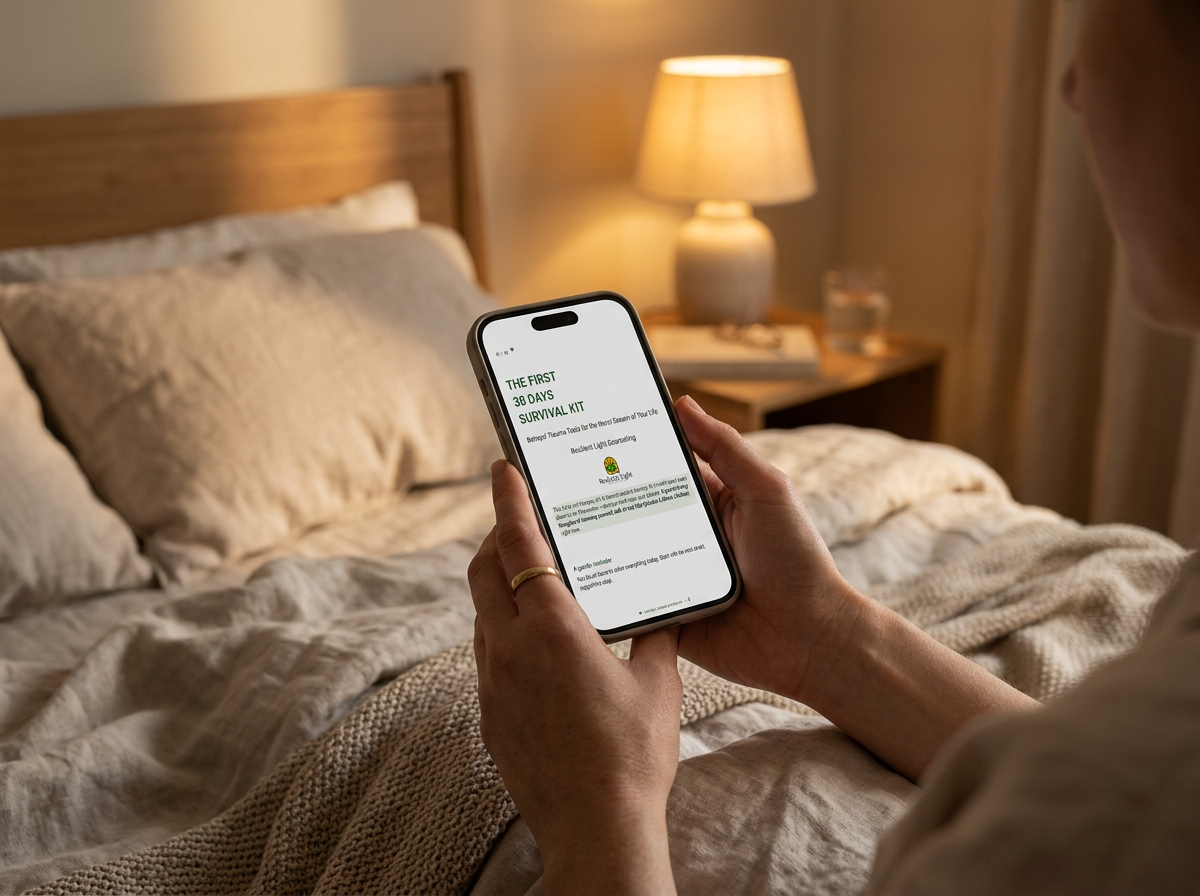
Download the free First 30 Days Survival Kit — seven tools matched to the seven symptom categories above
Read The Biology of Betrayal: What Your Brain Is Doing After Discovery Day
Schedule your free 15-minute consultation
Get the printable Symptoms Checklist for yourself, or to share with a friend who needs it